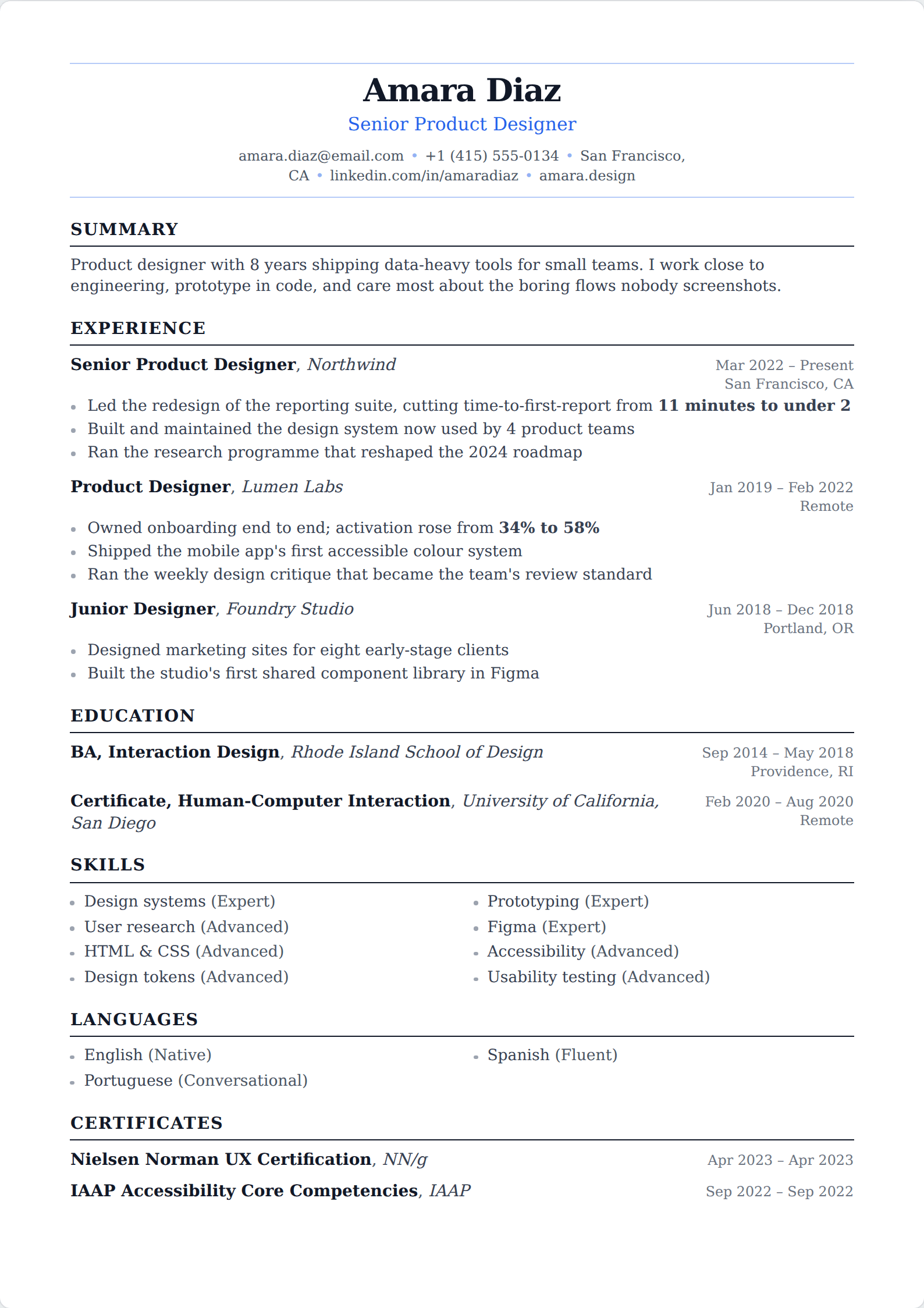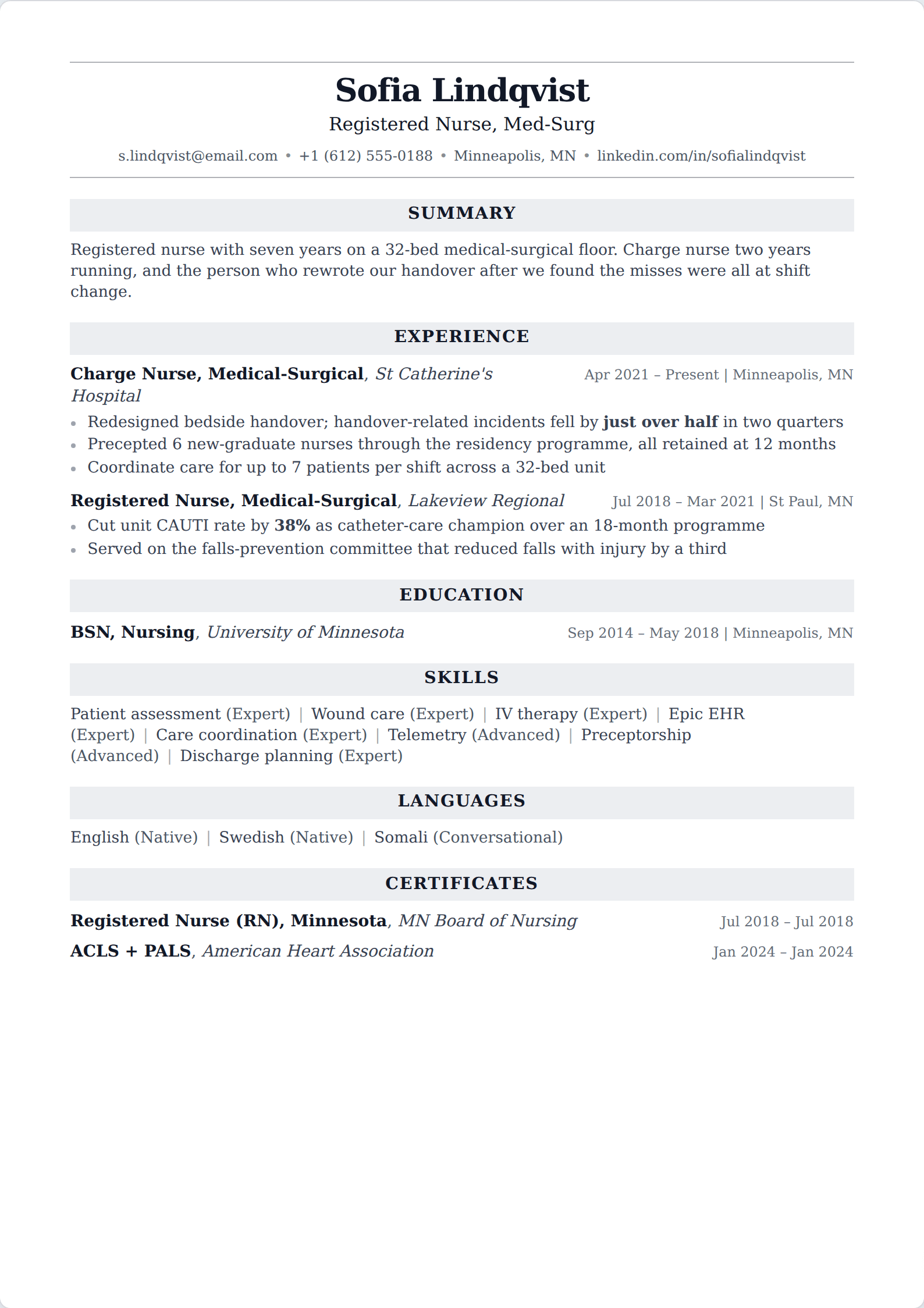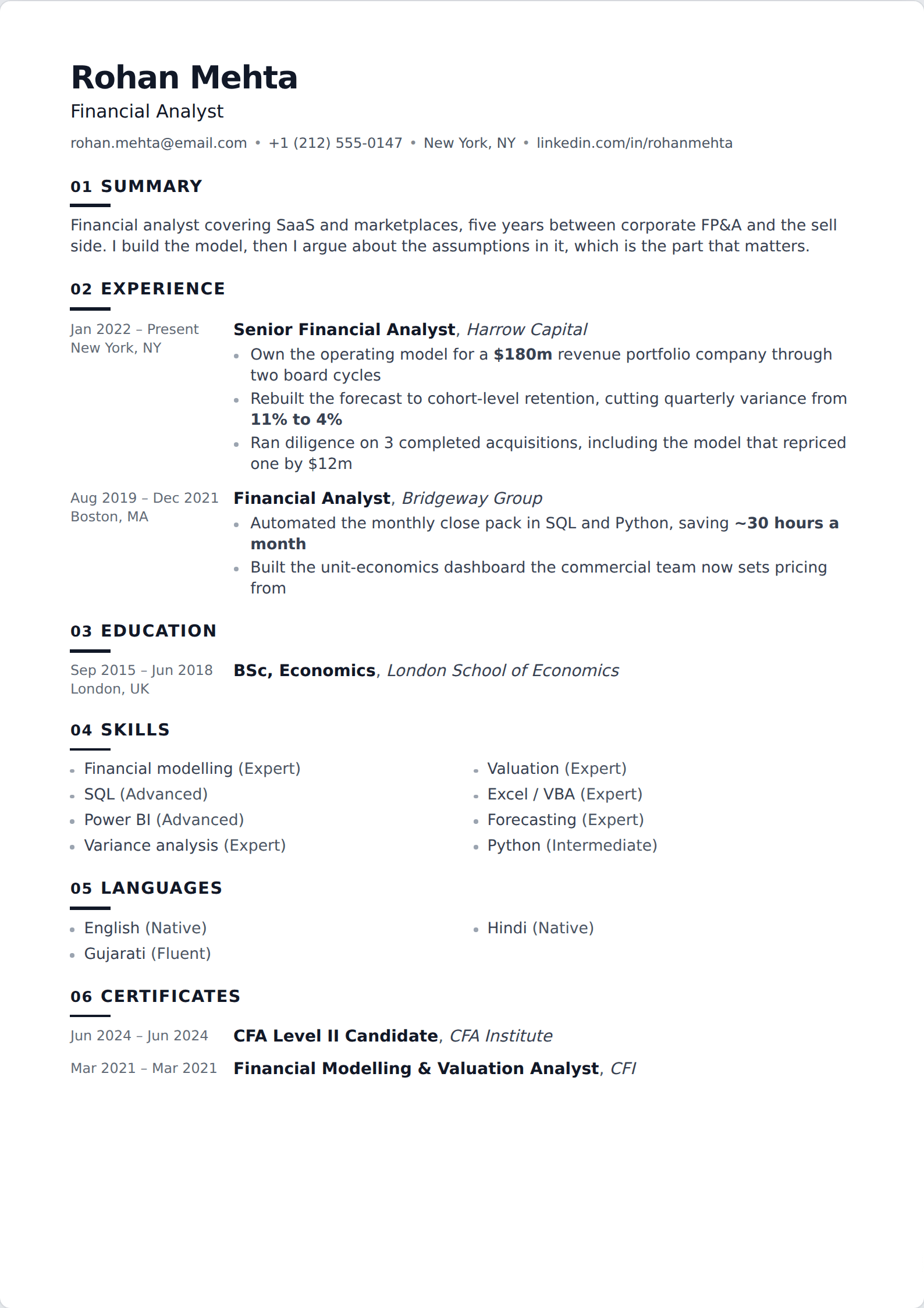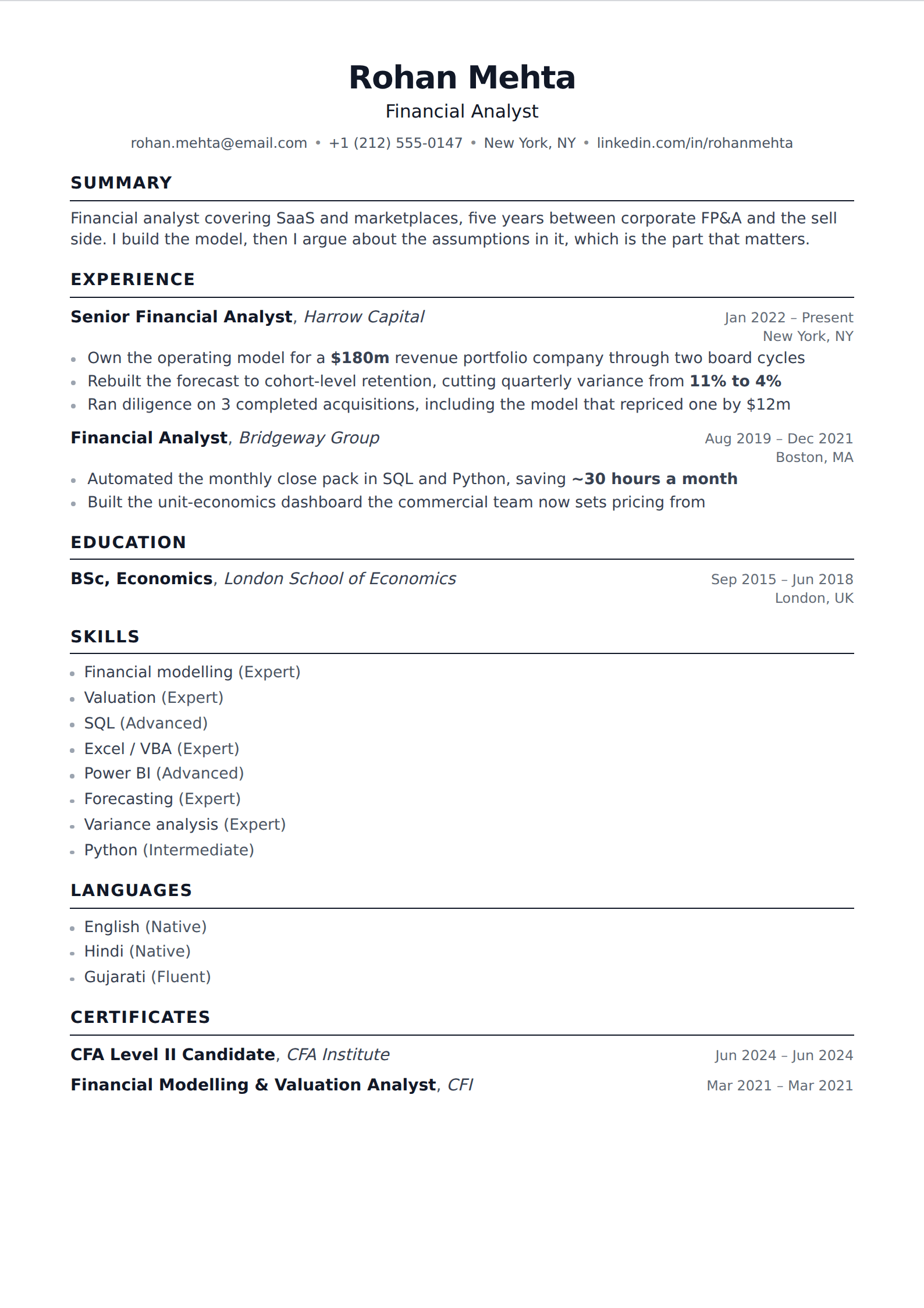

The order that works
Education first, always, and with more detail than an adult resume would carry — school, expected graduation date, GPA if it is above about 3.4, and any coursework that bears on what you are applying for. This is the one point in your life when your education section is the strongest thing on the page, and burying it below a summer job wastes it.
Then whichever of the following you have most of: work experience, activities and leadership, projects, volunteering. There is no fixed order among them. If you have held a part-time job for a year, that goes next, because sustained employment while at school is the single most persuasive thing a sixteen-year-old can show. If you have not, lead with the club you ran or the thing you built.
Skills last, and specific. Then stop. One page, and a high school resume that fills one page honestly is doing well.
- Contact details — name, email, phone, city. Use an email address that is your name.
- Education — school, expected graduation, GPA if strong, relevant coursework, honours.
- Experience — paid work, in reverse-chronological order.
- Activities and leadership — clubs, teams, student government, with what you actually did.
- Volunteering — with hours or duration, which is what makes it credible.
- Skills — software, languages, certifications like a food handler card, lifeguard certification or driving licence.
What counts as experience
Almost everything you have been dismissing. Babysitting is childcare with responsibility for a minor. Mowing lawns for six neighbours is a small business with repeat customers. Running the concession stand at football games is cash handling and inventory. Being treasurer of a club is budgeting. A summer at a family business is work.
The rule is not whether it was a formal job with a payslip. It is whether you turned up when you said you would, took responsibility for something, and can say what happened as a result. That is what an employer hiring for a first job is buying, and none of it requires a previous employer.
Coursework counts too, when it produced something. A history research paper is not a bullet; a history research paper that won a regional prize, or that you presented to a school board, is. What separates them is the outcome, which is exactly the same test an adult resume applies.
Writing bullets with no job titles
The pattern is identical to a professional resume — what you did, how much, what changed — and the amounts are simply smaller. Small does not mean weak. A specific small number reads as true, where a vague large claim reads as inflated.
"Worked at a restaurant" tells a reader nothing. "Ran the register on Friday and Saturday nights, about 90 customers a shift, and trained two new hires on the till" tells them you can handle volume, work unsocial hours, and be trusted to teach someone. Same job.
"Member of debate club" is a line. "Competed in 12 regional debates over two years; captained the team in senior year and organised the travel for eight people" is evidence of commitment and organisation, and it took the same amount of page space.
- Start with a verb: ran, organised, trained, built, raised, tracked, taught.
- Attach a number wherever one honestly exists — hours, people, customers, dollars, weeks.
- End with what changed, or what it enabled.
- Two or three bullets per entry is plenty. Nobody expects five.
For a job, and for a college application
They are not the same document, and using one for both weakens each. An employer wants reliability, availability and evidence you can be taught: lead with work, keep it to one page, and make your schedule and any certifications easy to find.
A college or scholarship reader wants depth and trajectory — did you stay with something long enough to get good at it, and did you take on more over time. That version leads with activities and leadership, states years of involvement explicitly, and gives more room to achievements than to duties. It can carry more detail about coursework and awards, because that is what is being assessed.
Keep one document with everything on it, and cut a version for each purpose. That is the same advice given to people thirty years into a career, and it works for the same reason.
The details that give it away
A few small things separate a high school resume that reads as competent from one that reads as a school assignment. An email address that is your name rather than a nickname from a game. A phone number you actually answer. Consistent date formatting. No photo. No objective statement saying you are seeking a position that will help you grow.
And no padding. A resume with eleven skills listed, three of which are "Microsoft Word", "communication" and "hard worker", reads worse than one with four real ones. At this stage a short honest page is completely normal, and a reader who is hiring for a first job knows exactly what to expect from a sixteen-year-old's resume. Meeting that expectation cleanly beats trying to look like something else.