
How to order it
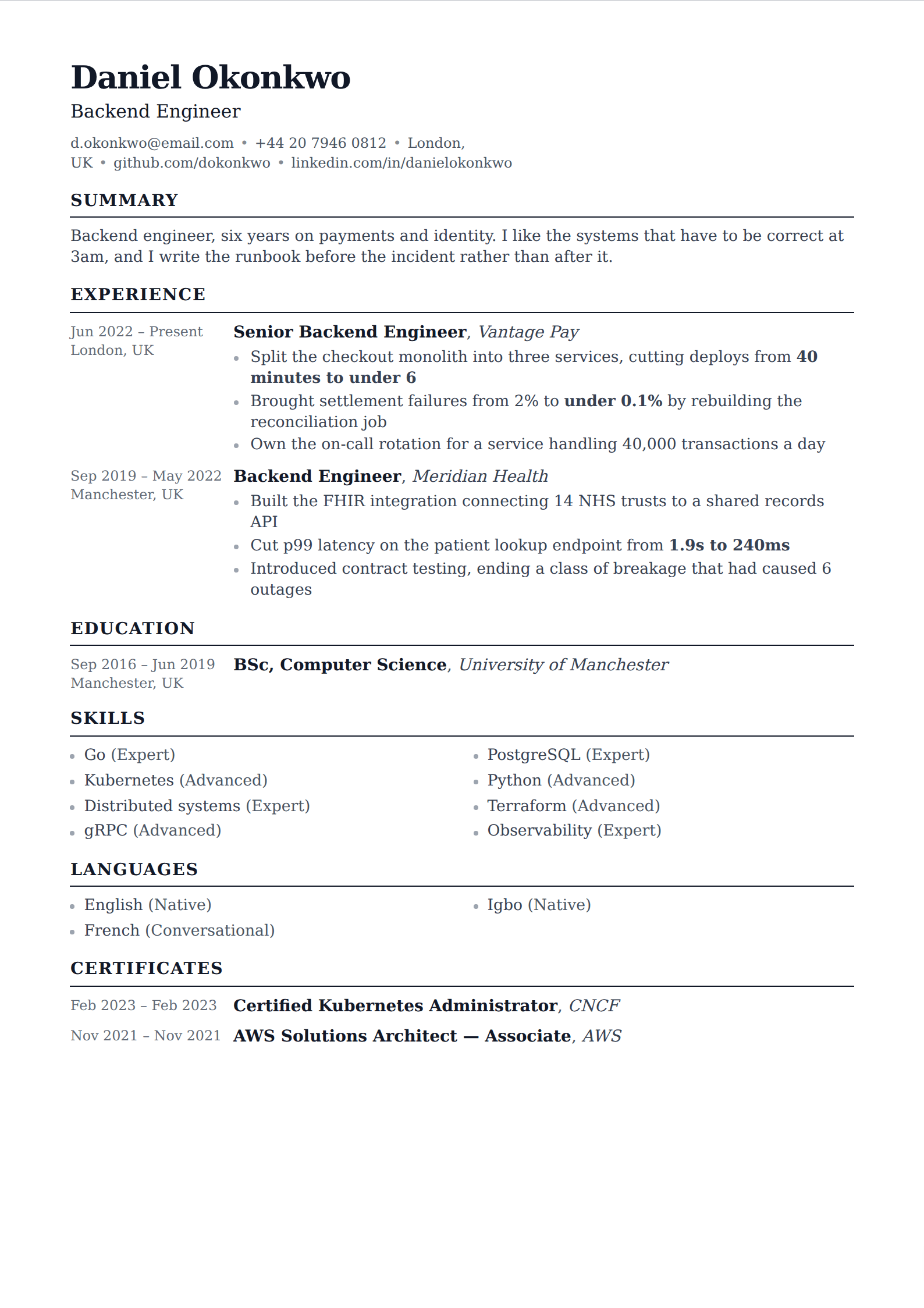
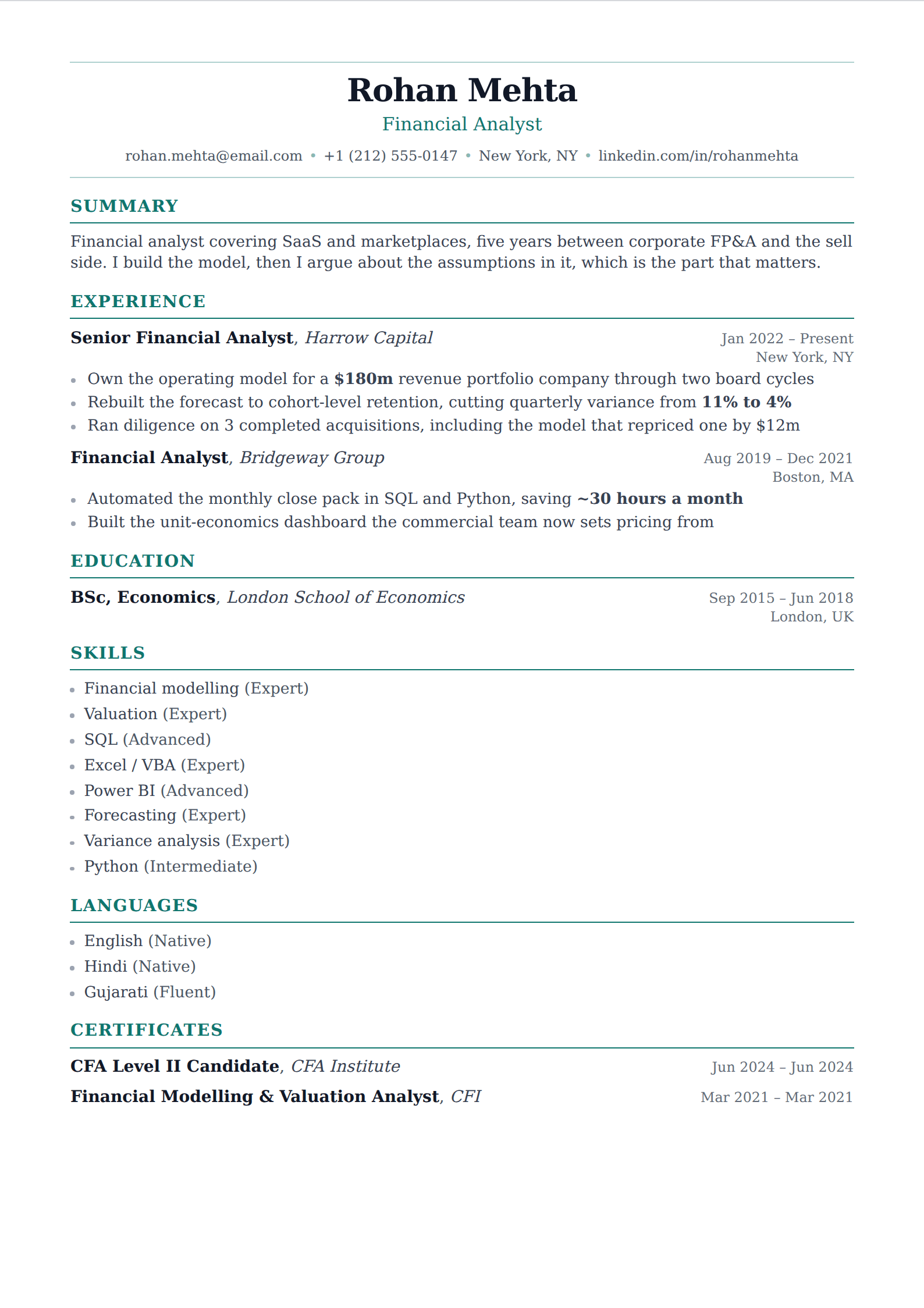
Education at the top while you are enrolled and for about the first two years after graduating, then it moves below experience permanently. The switch is not about time exactly; it is about whether your degree or your work is the more persuasive thing on the page, and for most people that flips somewhere in the second job.
Under education, include what actually helps: institution, degree, expected or actual graduation date, GPA if it is above roughly 3.4, relevant coursework if the role is technical, and thesis or dissertation topic if it bears on the job. Skip the rest — nobody needs your secondary school once you are at university.
Then experience, then projects, then skills. If your projects are stronger than your jobs, which is common for engineering and design students, put projects first and call the section Projects rather than trying to disguise them as employment.
Coursework and projects as evidence
A coursework list on its own is weak — it says what your department required, not what you can do. A project with an outcome is strong, and every degree produces several. The difference is whether you describe the assignment or what you produced.
"Completed a machine learning module" is department information. "Built a churn model on 40k customer records for a course project; the final version reached 0.82 AUC and the write-up was used as an example in the following year's class" is a thing you did, with a result, that could be discussed for ten minutes in an interview.
The same works outside technical fields. A dissertation becomes a project entry: the question, the method, the size of the dataset or archive, the finding. A group project becomes an entry about coordination as much as content. If you built anything that other people used — a society's website, a spreadsheet the committee still runs on — that is a project and it belongs on the page.
The part-time job you keep leaving off
Students routinely omit retail, hospitality and campus jobs on the grounds that they are irrelevant to a graduate role. They are not irrelevant. They are evidence that you held a commitment alongside a full course load for two years, which is exactly the reliability question a graduate recruiter is trying to answer and which no amount of coursework addresses.
Write it like a job, because it was one. Volume handled, responsibility taken, anything you improved, any promotion. A candidate who supervised weekend shifts at a supermarket while getting a 2:1 has demonstrated something a candidate with a clean academic record and no employment has not.
The exception is a job you held for three weeks four years ago. Duration is what makes this argument, so anything under a few months can go.
Applying for internships and graduate roles
Tailor per application, more than you think is proportionate. Graduate schemes receive thousands of near-identical resumes from people with the same degree, and a page visibly written for that employer stands out in a way it never will again later in your career.
That means matching the vocabulary of the posting in your skills section, promoting the project that resembles the work, and writing a summary — three sentences — that names the specific role you are aiming at. "Final-year economics student seeking a challenging role in a dynamic company" is filler. "Final-year economics student, dissertation on regional pricing dispersion, looking for a graduate analyst role where the work is closer to data than to slides" tells someone whether to keep reading.
One page. There is no situation in which an undergraduate resume needs two, and stretching to two makes the thin parts obvious.
Law, medicine and other structured tracks
Some fields have a house format that overrides general advice, and it is worth finding out rather than assuming. A law school resume expects education first with journal, moot and clinic involvement listed explicitly, and firms read the specifics closely. Medical and nursing applications expect clinical hours, rotations and licensure treated as their own sections.
Where a career services office publishes a format for your programme, use it. Those conventions exist because the readers are a small, repeat audience with fixed expectations, and matching them is a signal of fit rather than a failure of imagination. General resume advice — outcomes over duties, one page, no padding — still applies within whatever structure you are given.