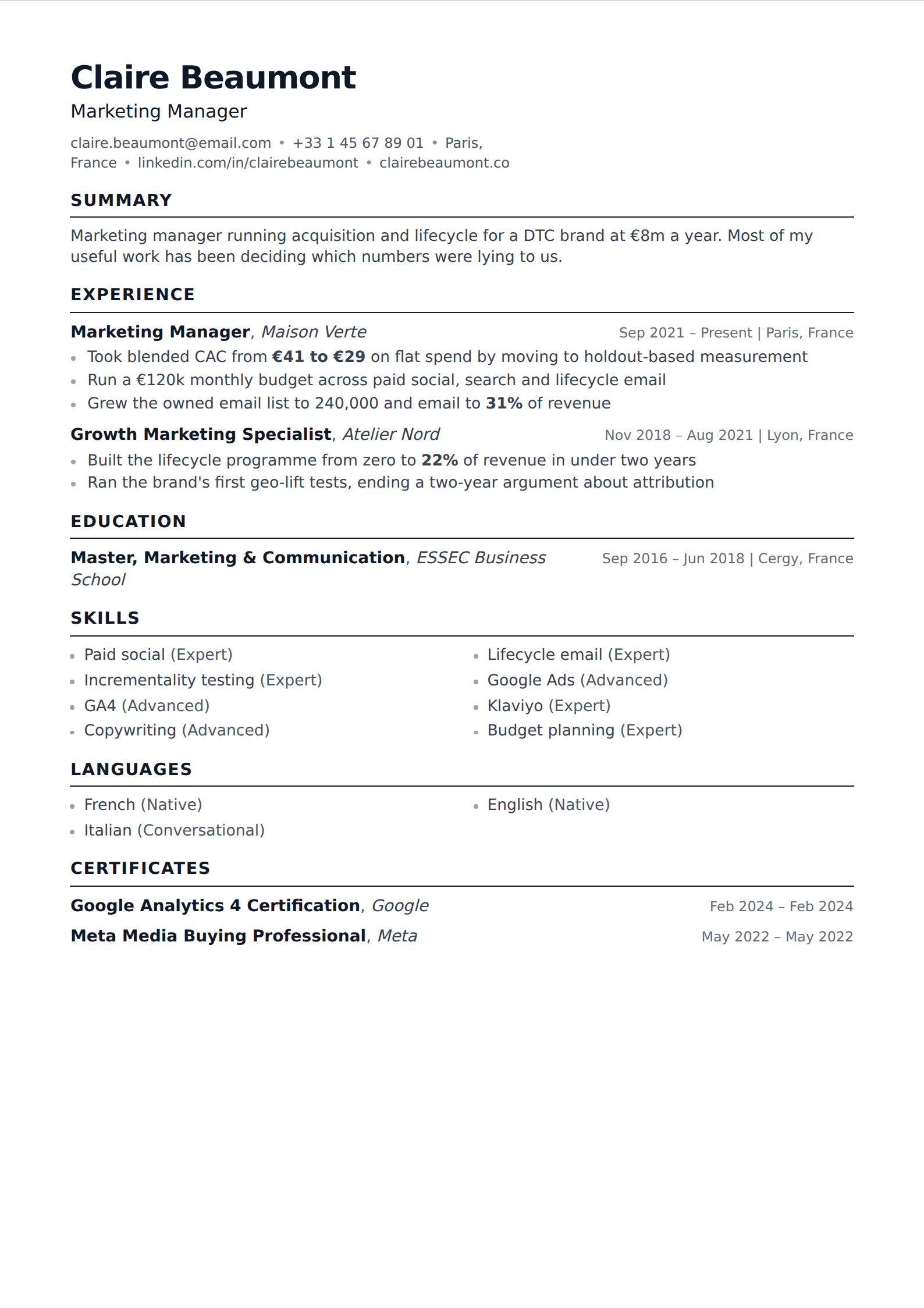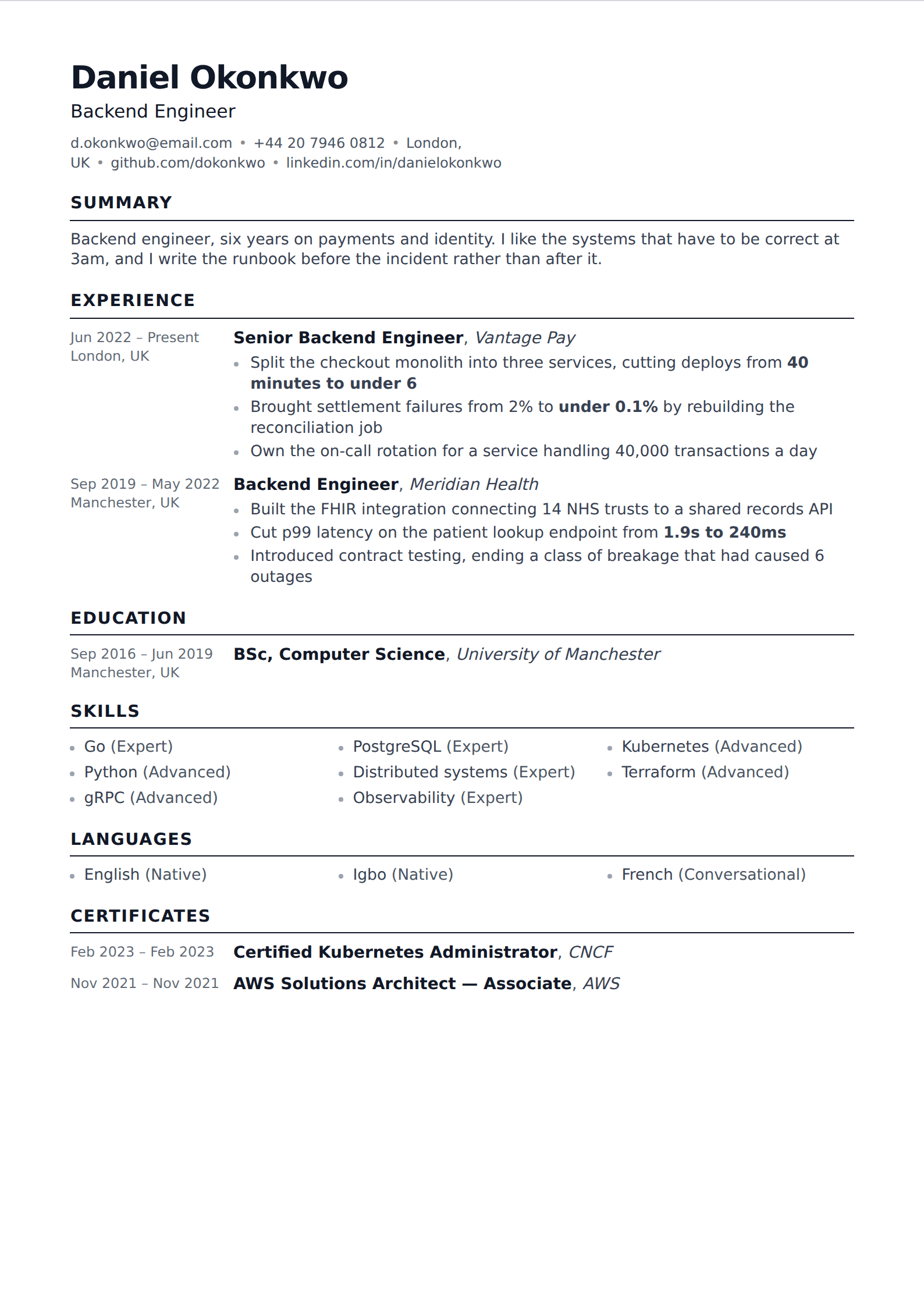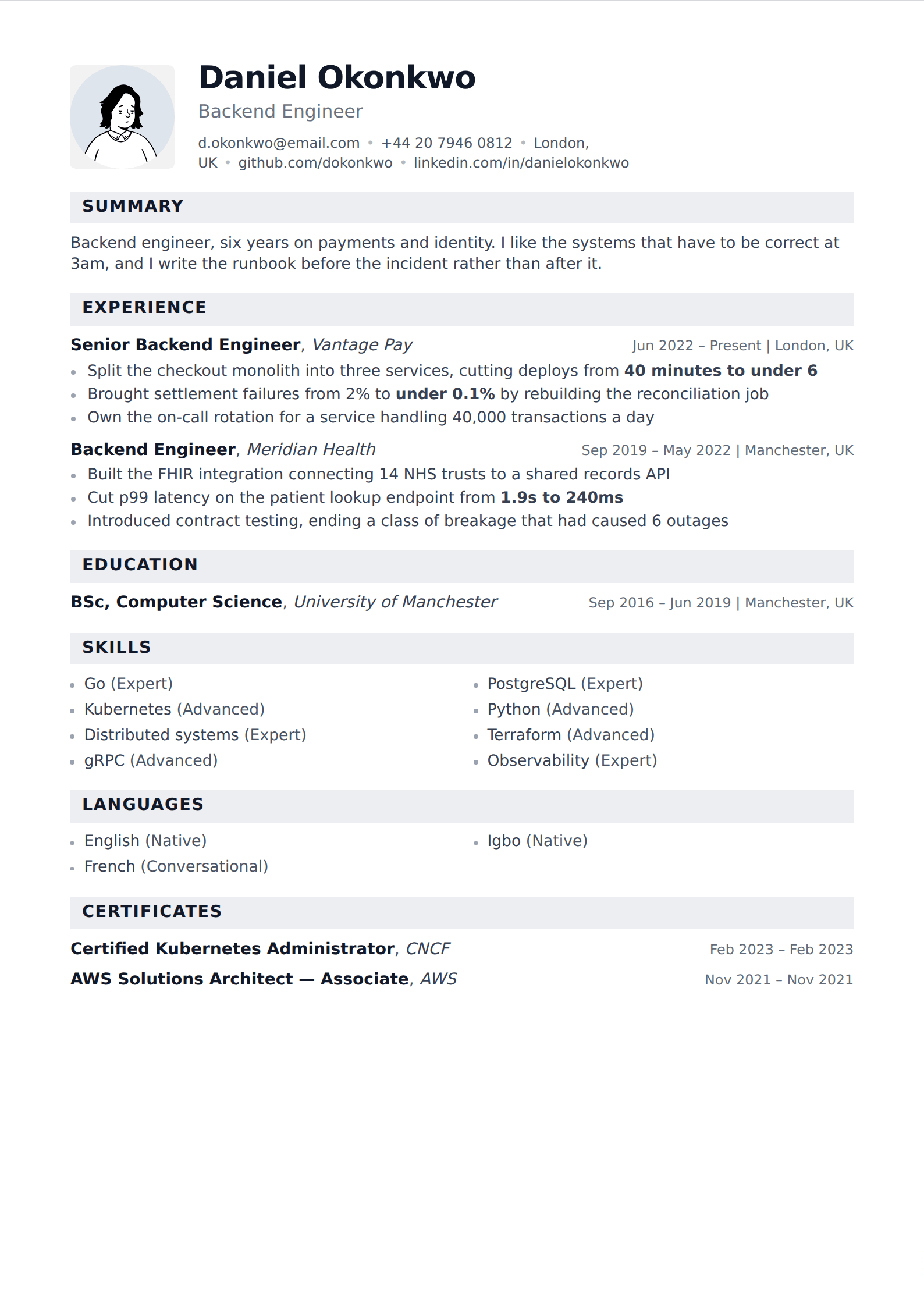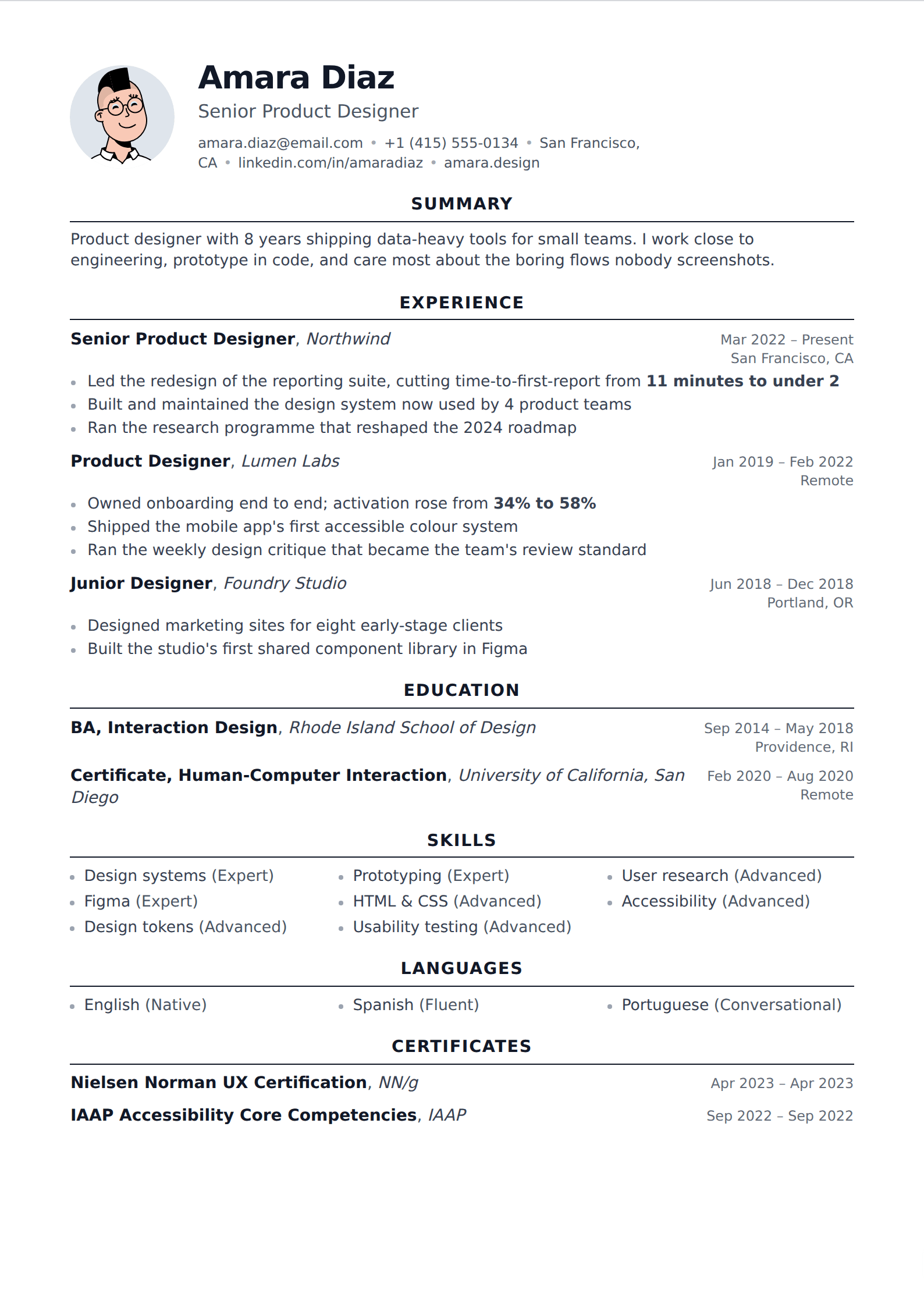

How it is built
Instead of roles in reverse-chronological order, the body of the page is three or four skill headings — Project Management, Client Relationships, Data Analysis — each with bullet points drawn from anywhere in your history. Employers and dates appear once, compressed into a short list near the bottom.
The theory is sound: it lets you lead with capability rather than with chronology, which is genuinely useful if your job titles undersell you.
Why recruiters distrust it
The problem is not that the format is ugly. It is that it removes the single thing a reader uses to calibrate everything else: when, and for how long, and in what context.
A bullet that says "led a team of twelve" means something different if it was last year than if it was in 2016, and different again if it lasted three months rather than three years. Strip the timeline out and every claim floats free of the context that would let someone judge it. Recruiters know this, which is why the format is read as concealment — and the reader's guess about what is being concealed is almost always worse than the truth.
There is a practical cost too. Applicant tracking systems parse into title/employer/date records. A functional resume gives them very little to work with, so it tends to rank poorly even before a human forms an opinion.
The cases where it genuinely helps
They exist and they are narrower than the advice suggests.
- A portfolio career of many short, unrelated contracts, where a strict chronology is a wall of noise rather than a narrative.
- Military or public-sector transitions where the job titles are meaningless outside the institution and the skills need translating before anything else.
- Academic or research work being pitched into industry, where the relevant experience is spread across projects rather than jobs.
- Very early career, where you have coursework, projects and part-time work but no employment history that a chronological format could organise.
The hybrid, which is usually the right answer
If you reached this page because someone recommended a functional resume for a career change or a gap, the format you actually want is the hybrid — and it solves the same problem without the cost.
A hybrid keeps the reverse-chronological history intact and puts a short skills section above it: three or four grouped capabilities with a line of evidence each, then the timeline underneath. The reader gets your argument first and the context immediately after, and the parser still finds the records it needs.
That combination is what most people mean when they say a functional resume helped them. It is worth being precise about, because the fully functional version is the one that costs you interviews.
What one actually looks like
Concretely, for someone moving from teaching into corporate training. After the contact block and a short summary, the page runs three skill headings before it reaches any employer.
Under "Curriculum design": built a semester-long curriculum for 120 students across three ability bands; rewrote the department's assessment framework, now used by six teachers. Under "Facilitation and delivery": taught 25 hours a week to groups of 30; ran the district's induction sessions for 40 new teachers across two years. Under "Programme measurement": introduced a tracking system that identified struggling students six weeks earlier than the previous process.
Then, and this is the part that decides whether the document works, a plain employment history at the bottom: employer, title, location, dates. Three lines, no bullets. That block is what stops the format reading as concealment and what gives a parser the records it needs.
Templates for it, and the parsing cost
There is no special functional template to find. Any single-column layout produces one — you are choosing which sections go in which order, not which design to buy, and a template marketed as functional is a normal template with the headings renamed.
What matters is that the layout keeps a clearly-labelled employment section at the bottom. Templates that drop the chronology entirely, or bury it in a sidebar, produce the version recruiters distrust and parsers mishandle: an applicant tracking system builds its record from title, employer and date triples, and a document without them can end up with an empty work-history field regardless of how much text is on the page.
The practical consequence is that the hybrid is easier to build as well as more effective. Take a standard chronological template, add two or three skill groupings above the experience section, and you have the readable version of this format without giving up the structure everything downstream depends on.